This is a tool to introduce the concept of Permaculture, and to demonstrate visually how everything is connected, and the importance of diversity in creating strong systems.
Objectives
- To introduce the general concept of permaculture, the design of sustainable systems, and to demonstrate visually many of the relationships between different elements in the system, in this case a vegetable garden.
- To visualise the way in which one element in the system can fulfill various functions, and likewise, that one function can be carried out by various elements.
- To facilitate the group dynamic process at the beginning of the course (the activity can be used as a thematic ice-breaker).
Learning objectives:
- To learn the design of sustainable systemsTo raise participants´ awareness that in the specific case of Permaculture we are dealing with a way of thinking and designing, taking into consideration the needs and products of all the possible elements within a system.
Materials
- Ball of string.
- Name cards (big enough to be visible to all other participants) for example: Compost Heap, Bees, Ducks, Pond, Fruit Trees, Aromatic Herbs, Straw, Vegetables, Us, Slugs.
- Other cards which can be added depending on the number of participants: Flowers, Birds, Seeds, Chicken, Rain, Snails, Earthworms, Greenhouse etc.
See Documents Section
Implementation
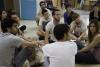
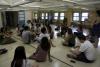
The participants stand in a circle.
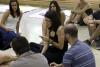
We distribute the cards: each person receives one or more name cards, previously prepared (if there are fewer than 10 people they can have 2 cards each).
The participants can briefly read out their roles, in case any clarification is required.
We give the end of the string to one person, and ask to find a connection with another member of the group, justify the connection, and pass the ball of a string to that other person. For example: the person with "Ducks" starts, keeps the end of the string and passes the ball to the person with "Slugs" with the reasoning that ducks eat slugs; "Slugs" wraps the string round a finger and passes the ball to "Vegetables" (because slugs eat vegetables at times); "Vegetables" can benefit from "Compost"; "Compost" can be put round "Fruit Trees"; "Fruit Trees" need pollinating by "Bees"; "Bees" can provide "Us" with honey etc etc etc.
If necessary, one of the facilitators can assist with the passing of the string.
The activity continues until the ball of string runs out. Obviously connections cannot be repeated, but the string can go to the same person several times, if it comes from different places.
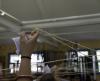
As each element potentially has links with many of the others, the final result is the equivalent of a large spider´s web, one which demonstrates the strength of a diverse inter-related system.
Evaluation
Evaluation:
Evaluation after the exercise relates to the participants´ feelings, how it was for them, and on the other hand reflects their understanding and reflection about the topic. Some possible questions which can be asked:
- What did you learn/discover during the activity?
- What did you like/dislike about the activity?
- How, if possible, can you use it in your context?
Tips
Tips:
This activity is used at the beginning of a 10-hour course. Therefore, on one hand it can encourage interaction amongst the participants right from the beginning of the longer activity, on the other hand it can be used as an exercise which in a practical and visual way demonstrates the ideas and concepts which otherwise would be abstract theory, as well as serves as a good foundation to the topic and is often referred to in subsequent sessions.
When we say in the objective ´to demonstrate visually many of the relationships between different elements in a system´- in this case, a vegetable garden and the importance of diversity in creating a strong and healthy system - this can be shown visually if the 'game' is continued, and once created the web, one or more elements are removed. Although the 'system' may be slightly unbalanced, there are still sufficient connections to maintain a relatively strong web.
The example of an element which can fulfil various functions could be a CHICKEN - it can eat weeds, and weed seeds; it can provide manure for the compost heap; it will eat kitchen waste if desired; it can provide warmth; and it will kindly provide an egg most days. In fact this would be well illustrated with any of the elements which end up having many strings connected to them.
Equally, one function can be carried out by various elements, for example FOOD for us.
When we speak about raising awareness of participants in the specific case of Permaculture, we are dealing with a way of thinking and designing, taking into consideration the needs and products of all the possible elements within a system, and thus finding the way to locate the elements so that the interactions between them are most beneficial to the elements themselves and to the system as a whole, and that the consumption of energy (including ours) and resources is as minimal and efficient as possible.
Number of participants: 10 to 20 (if fewer than 10 people, they can have 2 cards each).
Time for activity: 45-60 minutes
Variations:
As far as the elements are concerned, we tend to use ones with a horticultural slant: Bees, Water, Compost, Vegetables, etc. But the subject matter could easily be amended depending on the group's needs, for example a CITYSCAPE: School, Library, Town Hall, Shops etc.